
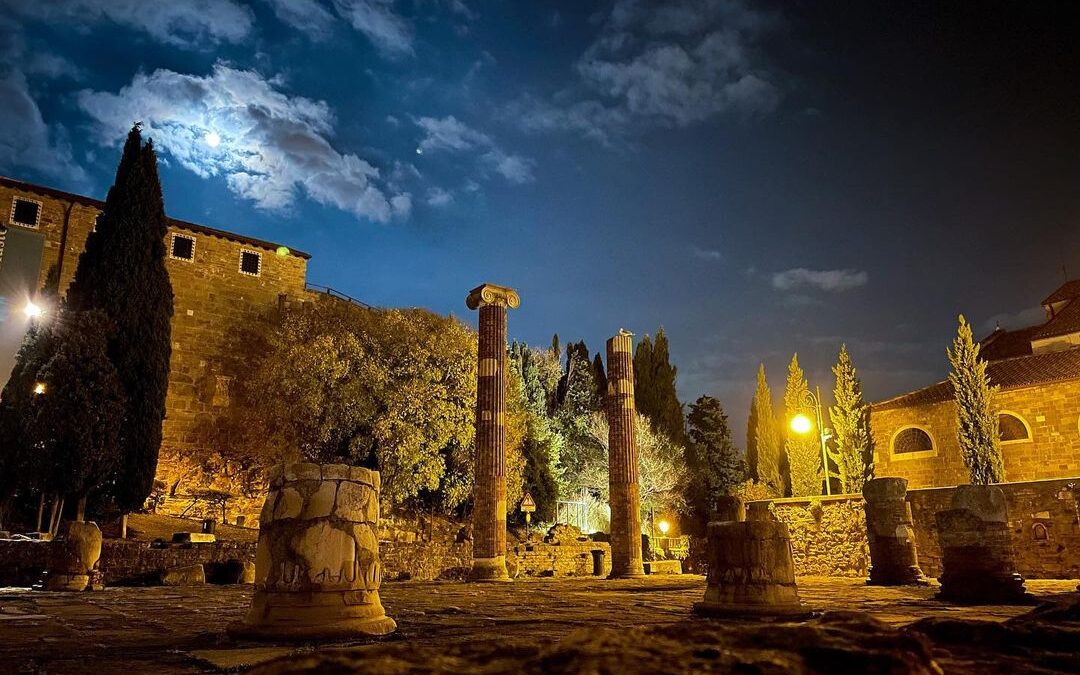
Trieste, today a city of borders and a bridge between cultures, still preserves numerous traces of its Roman past. Founded as a colony under the name Tergeste, probably in the 1st century BC, the city developed thanks to its strategic position on the Adriatic Sea and its connections with the hinterland. Even today, while walking through the historic center, one can encounter monuments and remains that bear witness to the presence and urban organization of the Roman era.
The Roman Theatre
The most visible and fascinating monument is undoubtedly the Roman Theatre, built between the late 1st and early 2nd century AD, during the reign of Emperor Trajan. Located at the foot of San Giusto Hill, it could accommodate up to 6,000 spectators. The seating, partly carved into the natural slope of the hill, still gives an impression of the building’s grandeur. In ancient times, the cavea was decorated with statues and inscriptions dedicated to prominent figures of the colony.
The City Walls and Gates
Another important legacy is the Roman walls, which surrounded the city to defend it and define its borders. Some sections have been uncovered and incorporated into later buildings on San Giusto Hill. Notable are the remains of the ancient gates, which marked the entrances to the city and reflected its military and civic organization.
The Forum and Civic Structures
The center of Roman public life was the forum, now identified in the area of Piazza Cavana and Piazza della Borsa. Here political, administrative, and commercial activities took place. Excavations have revealed pavements and artifacts confirming the presence of public buildings and porticoes.
The Aqueduct and Infrastructure
Like every Roman colony, Tergeste also had an efficient water system. Remains of aqueducts and cisterns have been found in the Karst area and near the city. In particular, archaeologists suggest the existence of an aqueduct that carried water from the Bagnoli della Rosandra area to the settlement, supplying the population and the thermal baths.
Other Roman Remains
- Basilica forensis: remains of a basilica used for civic and judicial purposes have been discovered near the forum.
- Inscriptions and epitaphs: scattered between San Giusto Hill and local museums, numerous inscriptions tell the stories of Tergeste’s citizens, merchants, and soldiers.
- Private houses: various urban excavations have uncovered mosaics and remains of Roman domus, reflecting the refined and organized daily life of the time.
Conclusion
The traces of Ancient Rome in Trieste are precious fragments that allow us to reconstruct the city’s history and understand the role of Tergeste as a Roman outpost on the Adriatic. Walking through the theatre, San Giusto Hill, the central squares, and the museums means experiencing the historical layers that still shape the face of the city today.
Massimo Battistutta
- Culture and tourism
- Pilabank.eth